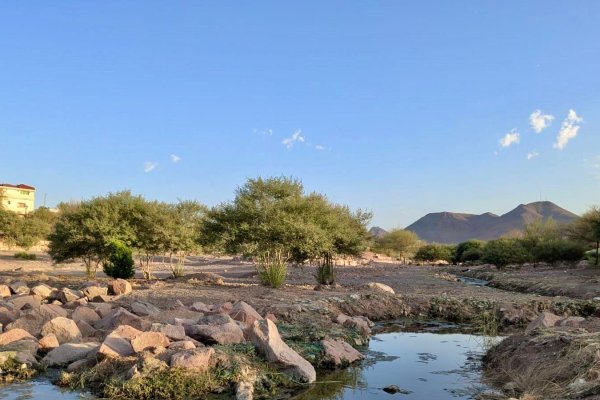
You might not find them on mainstream sightseeing lists, but the wadis of Madinah are imbued with both history and spiritual significance. Learn more about these natural formations that have transformed and adapted from pre-Islamic times to the present day.
Through their undulating and delicately winding contours, wadis expose the blueprints of ancient landscapes and echo both historical truths and ancient human inclination. They are dry valleys, common in arid and semi-arid regions of the Arabian Peninsula. The Arabic term comes from the root wada or “to flow”, conveying the ephemeral nature of these gaping spaces, which are shaped and reshaped by the natural flow of water, sediment, gravity and the inevitable human traffic that follows.
Equally, wadis are a stubborn reminder of Mother Earth’s unpredictable temperament. While in heavily populated regions they arbitrarily divide urban fabric, due to the risk of flash floods in such arid climates, the contemporary desert city planner must accommodate this clairvoyant, ancient force into sustainable development efforts. Despite the interminable march of urban sprawl, the wadi stands on deeply rooted ground.
They therefore become strategic tools in the development of green infrastructure, based on traditions and human movement that date back to the furthest annals of history, creating an interconnected chain in time and place. Nowhere is this more poignant than in Saudi Arabia's ancient city of Madinah, the second-holiest site in the Islamic world and the birthplace of Islamic civilisation.
Madinah’s sacred geography is shaped by, and itself shapes, Islamic history, and its landscape is replete with sites of religious significance.
Madinians in Islamic history are known as the ansar, the “helpers” or “supporters” of the earliest Muslims, a fact that imbues the city with a soul deemed endlessly open and accommodating. This model of altruism is inextricably linked to the now-stretching modern city, which many expect to remain static in time and resist the equally inevitable draw of cold, hard utility and practical function. Development in the city must therefore tread a careful line between tempering natural forces – preserving religious heritage while still humanising its geography for both residents and soul-searching pilgrims who enter the city in their millions each year.
The two main wadis that tear through the city of Madinah are Wadi Al-Aqeeq, which cuts from the south across the city’s entire western border, and Wadi Qanat, a seasonal stream which snakes modestly between Mount Uhud to the city's north, bifurcating its centre.
In pre-Islamic history they were drivers of regional development, providing the foundation for agriculture, commerce and tourism in the city. The wadis of Madinah made the ancient city of Yathrib a major regional centre in the peninsula and secured its position as an agricultural oasis and cosmopolitan settlement, attracting diverse populations – a fact mirrored in the increasing diversity of today’s inhabitants. Significantly, both wadis feature heavily in Islamic canonical hadith literature and are therefore equally sites of religious possession. Like other landmarks in Madinah, they assume the role of poetic spaces of the collective spiritual consciousness, acting as existential anchors and vessels for collective aspiration. Add to this the physical challenges innate to modern wadi development, and it is clear that city planners are not just mediators between water and built environment, but the popular adulation and expectation of imagined geography too.
Despite the physical and cultural challenges, recent developments to both Wadis have satiated these many competing appetites. Employing, rather than fighting the underlying logic of these hydrological backbones, the Madinah Municipality has incorporated these water basins into the city’s green infrastructure – utilising them to lower urban temperatures, improve air quality and bring nature into living space. Considerable afforestation, vegetation development and land-rehabilitation efforts designed to support native flora and fauna help the wadis to retain ecological balance and preserve the areas’ biodiversity, returning them to their original function of desert oasis, and places of wonder and beauty outside of the city’s dense urban core.
Development has crucially incorporated public squares and extended walkways paved with local basalt and granite. Ground lighting and cultural plazas have been established to ensure the wadis retain their ancient role of balancing overlapping active geological systems, drawing community, movement and life to their doors. It has also included the preservation of key archaeological sites, such as the Castle of Urwah on the banks of Wadi Al-Aqeeq, incorporating historical signage and subsequently creating porous, open-air museums which adorn its meandering trail. The Castle of Urwah is perhaps most emblematic of the way development in Madinah has married historical and religious legacy with modern needs – as it currently overlooks an outdoor community gym and children’s playground – drawing residents and tourists to these dynamic and vibrant spaces that are being rewritten in real time.
The ecological, social and spiritual flow of the wadis of Madinah pulsates life and energy into the city, connecting it to a past that is cherished by humanity beyond the borders of time and space. The wadis fulfil a blessed function of joining the people of Madinah, its nature and expectant visitors together at once in these breathing historical spaces that stretch into the realm of collective imagination.
